

How to Prepare for Tupping: A Practical Guide for Sheep Farmers
Get ewes and rams ready for tupping. Body condition, flushing, ram MOTs, ram ratios, worming and a week-by-week checklist from sheep farmers who've done it.
What is tupping in sheep?
Tupping is the mating season, when rams (tups) are turned in with ewes. Most of next spring's lambing percentage is decided in the eight weeks before the rams go in, not on the day itself.
A ewe's ovulation rate, how many eggs she releases, responds to her condition and nutrition in the run-up to tupping. Get it right and you get more twins, a tighter lambing and fewer empties at scanning. Get it wrong and no amount of feeding in late pregnancy will put those lambs back.
This guide covers how to get both ewes and rams ready, how many rams you need, how long to leave them in, and a simple countdown you can pin up in the shed.
Why is it called tupping?
"Tup" is an old word for a ram, still used across northern England and Scotland. It dates back to Middle English, and "tupping" simply means the tup doing his job. In the south you'll hear "ram" more often, but the season is called tupping almost everywhere in the UK.
How do I get my ewes ready for tupping?
Start at weaning, around 10 to 12 weeks before the rams go in. That gives thin ewes time to recover condition on grass, which is far cheaper than trying to fix them with feed later.
Body condition score (BCS)
Body condition scoring is the single most useful job before tupping. Handle every ewe over the loin and split them into groups.
Lowland - 3.0-3.5
Upland - 2.5-3.0
Hill - 2.0-2.5
Put thin ewes on the best grazing straight after weaning. Fat ewes can go on tighter grazing. Aim for a level flock, because the ewes furthest from target are where the barren and single-lamb results come from.
Cull hard
The same handling is the time to cull. Check every ewe's teeth, udder (lumps, hard quarters, lost teats) and feet. A ewe with a bad udder will cost you next spring.
What to give ewes before tupping: flushing
Flushing means putting ewes on a rising plane of nutrition for 2 to 3 weeks before tupping and keeping them there for around a month after. It works best on ewes that are close to target condition rather than fat ones. Good fresh grass is usually all you need; concentrates are only worth it if grass is short.
Keep the plane steady after the rams go in. A sudden drop in feed or a stressful move in the first month can cause early embryo losses.
Should you worm ewes before tupping?
Not as a blanket treatment. Healthy adult ewes usually have decent immunity to worms, and routine dosing speeds up wormer resistance. Instead:
- Run a faecal egg count (FEC) on a sample of ewes
- Treat thin ewes and any group the FEC shows needs it
- Leave some fit ewes untreated to keep worms susceptible to wormers on the farm
Check for liver fluke separately, especially in wet years and on known fluke ground. Your vet can advise on timing and the right product. The SCOPS guidelines are the industry standard here.
Trace elements
Cobalt, selenium and iodine deficiencies all hit fertility and lamb vigour. Do not dose blind: blood test a handful of ewes through your vet first, then supplement only what is short.
Vaccines
If you vaccinate against enzootic abortion and toxoplasmosis, it has to be done before tupping, typically at least 3 to 4 weeks before the rams go in. Check the product data sheet and plan the date into your calendar. Clostridial boosters are often given at the same handling.
What should you not feed sheep around tupping?
- Red clover-rich leys: they contain plant oestrogens that can cut conception rates. Keep ewes off them for 6 weeks before and during tupping
- Sudden diet changes, especially big jumps in concentrates
- Cattle feeds and minerals: sheep are very sensitive to copper
- Poisonous plants such as yew, rhododendron, laurel, ragwort and bracken, which are a risk all year
Getting rams ready for tupping
A ram is half your flock's genetics and, at tupping, all of its fertility. Sperm takes around 7 weeks to produce, so anything that knocks a ram (lameness, a fever, poor condition) 2 months before tupping shows up as empty ewes. Check rams 10 to 12 weeks out, while there's still time to fix problems or buy a replacement.
The ram MOT: the five Ts
- Toes: lame rams won't work. Treat feet early
- Teeth: a ram that can't graze won't hold condition
- Testicles: both should be firm, even and move freely in the scrotum, with no lumps. Size matters; get your vet to check any doubts
- Tone: aim for BCS 3.5 to 4 at turnout. Rams can lose a full condition score during tupping
- Treatment: vaccinate, check for worms and fluke, and quarantine any bought-in ram for at least 3 weeks
For valuable rams or any doubt, a vet fertility test (including a semen check) is cheap insurance.
How many rams do I need for 100 ewes?
Ram lamb - 1:20-30
Shearling - 1:40-60
Mature ram - 1:50-80
For 100 ewes, plan on two mature rams. Running a spare is wise: if one ram fails, a single sire can leave a lot of empty ewes before anyone notices. Big, rough or steep fields need more rams than small flat paddocks.
How many ewes can an 18 month old ram breed daily?
A fit shearling can comfortably serve several ewes a day. The real limit is how many ewes are bulling at once. If you synchronise ewes, or put a young ram with too many, use the lower end of the ratios above.
Use a raddle
Fit a raddle harness or apply raddle paste and change the colour every 16 to 17 days, one ewe cycle. Lots of repeats on the second colour points to an infertile ram. It also gives you lambing groups for free.
Teaser rams
A vasectomised teaser run with ewes for about 14 days before the working rams go in brings ewes into season together. That gives a tighter, more manageable lambing.
How long to leave rams with ewes?
Two full cycles is the minimum, about 34 days. Many farmers allow three cycles, around 6 weeks, then take the rams out. Longer than that and you're lambing stragglers for weeks.
Can a ram run with ewes all year round?
He can, but most commercial flocks shouldn't let him. You lose control of when lambs arrive, which makes housing, feeding, scanning and vaccination timing much harder. Ewe lambs can get caught too young, and rams lose condition and fight. Some breeds, such as Dorsets, will cycle out of season too, so year-round running can mean year-round lambing. Run rams separately and turn them in on a planned date.
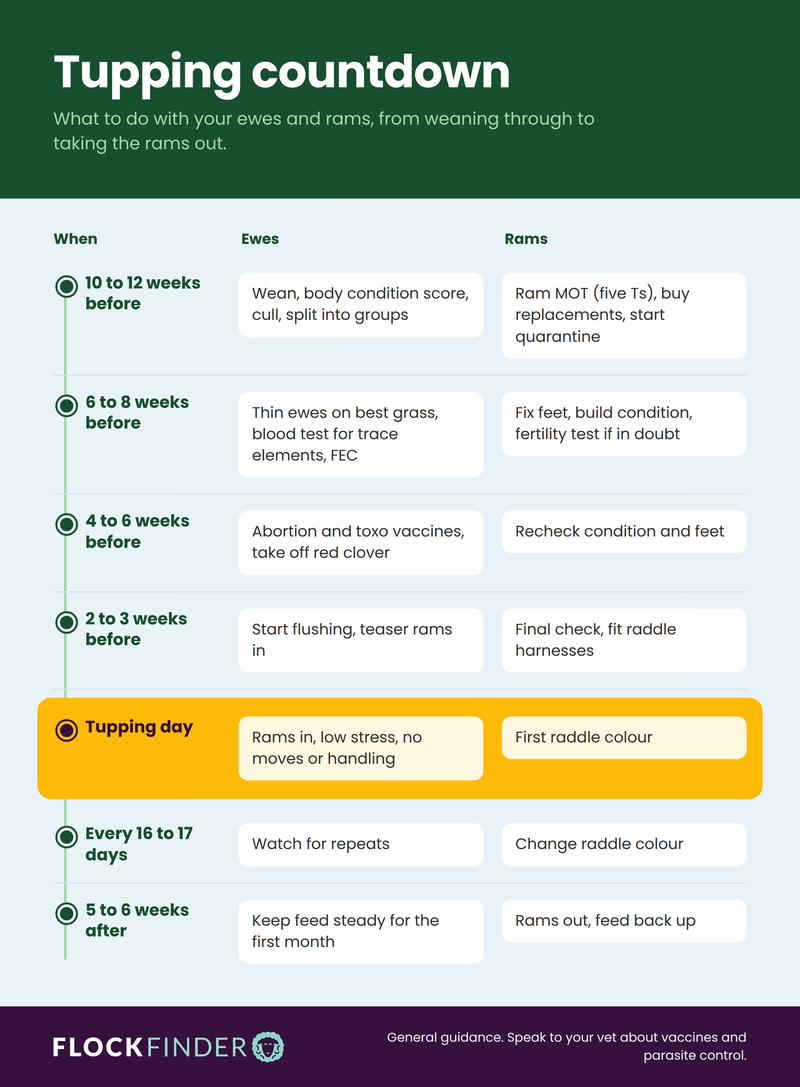
Tupping countdown checklist
Join the flock!
30 days free, no payment details needed